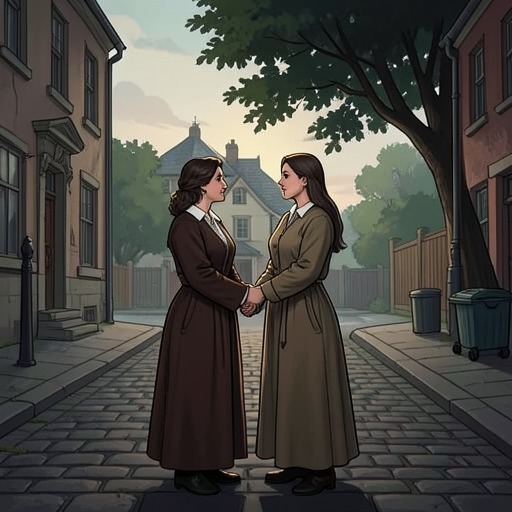
Best friends forever
Firefly Lane“Best friends forever” is the defining expression of Tully Hart and Kate Mularkey’s friendship: a childhood vow that makes their bond feel like safety, gives them a shared language for their past, and becomes painful when the promise no longer matches the present. Its significance lies in that change of meaning. Spoken earnestly in adolescence, it imagines a lifetime together; remembered after a rupture, it exposes the loneliness of trying to live without the person who had seemed permanent.
The Promise and Its First Meaning
The vow takes shape when Kate asks for honesty and Tully answers with a promise of permanence. Kate says they will be best friends forever and asks whether that means she will always be there for Tully. Kate answers, “Always,” and adds, “No matter what.” Tully promises the same in return. The exchange is more than an affectionate phrase: it gives the friendship a rule of mutual presence, with each girl making herself answerable to the other.
For Tully, the assurance reaches beyond ordinary companionship. She feels an opening inside her, compares it to an exotic flower, and imagines its honeyed scent; for the first time, she feels totally safe with someone. The language of forever answers a particular vulnerability by making care seem dependable. The vow’s emotional force comes from the difference between Tully’s earlier uncertainty and the security she experiences in this moment.
The promise also imagines a future. The girls picture themselves as old women in rocking chairs on a creaking deck, laughing together about their lives. That shared image turns an adolescent pledge into a lifelong horizon: the future is not merely long, but populated by the same two friends, still able to look back together. Their expectation gives the phrase its warmth, while the later loss of that expected future gives it its ache.
A Shared Language for a Shared Life
As the friendship grows, the phrase belongs to a larger pattern of closeness. Tully and Kate share stolen cigarettes, cry to the lyrics of “Billy, Don’t Be a Hero,” and tell each other everything. They stitch their lives together until people around them treat the two as a single unit, “TullyandKate.” For more than thirty years, their friendship serves as a bulkhead in their lives: the music changes with the decades, but the promises made on Firefly Lane remain.
“Forever friends, no matter what” is also Tully’s way of describing what Kate has done, not simply what the two once pledged. Remembering that her mother abandoned her and that her grandmother died, Tully points to Kate as the person who was there, held her hand, and took her in. She calls them a team and renews the promise as they prepare for the first day of school. The vow thus gathers concrete acts of loyalty beneath its broad claim: Kate’s importance is measured in moments when Tully needed someone and Kate stayed.
The words “Remember Firefly Lane?” become shorthand for this history. Tully explains that the phrase recalls a friendship begun at fourteen, when David Cassidy was groovy and a song could make them cry, and carries the belief that it would last forever. In this use, the original setting is not just a place-name but an entry point into a shared store of memories. Saying it lets the friends invoke an entire past without retelling each episode.
The Promise Under Pressure
The vow’s absoluteness makes it vulnerable to the distance that later grows between the friends. The book’s remembered picture of the rocking-chair future returns in the aftermath of their estrangement, but now as something the friendship once expected rather than something they can assume. For more than a year, Kate has been telling herself that she can go on without a best friend. Sometimes she believes it; the qualification reveals how hard that self-reassurance is to sustain.
The memory returns through ordinary music. While shopping, Kate hears a bad Muzak version of “You’ve Got a Friend” beside the radishes and cries. The setting is unceremonious, but the song reconnects her to the friendship’s music and to what its promise once meant. The scene contrasts the scale of “forever” with an everyday interruption: a melody can bring the absent friend back into feeling even when the friendship is not present in Kate’s life as it used to be.
In another recollection, the words “Best friends forever” surface after Kate wakes from a dream of Firefly Lane, with tears on her cheeks and a winter storm outside. She has recently found it harder to distance herself from memories. The vow recurs not as proof that everything remains intact, but as a phrase that keeps returning when she cannot hold the past at a safe distance. Its repetition binds the childhood promise to adult grief without erasing the change between them.
Meaning Across Time
The expression carries two truths at once: the friendship offered real safety and sustained loyalty, and the promise of permanence could not prevent later separation. Tully’s childhood sense of security, Kate’s history of being there for her, and their decades of shared language give the vow substance beyond sentiment. Yet the later attempt to live without a best friend shows that the words cannot by themselves guarantee an unbroken relationship.
That tension is what makes the phrase a recurring measure of the bond. In youth, “forever” names a future the girls believe they will inhabit together; in memory, Firefly Lane condenses the years and songs that made that belief credible; after estrangement, the same language exposes the absence the friends are trying to endure. “Best friends forever” therefore remains both a promise of chosen presence and a reminder of how painful it is when an imagined permanence is lost.